.png)
BY: BONNIE STRATI
We live in a culture that celebrates intensity. Work harder. Move faster. Push through. Do more.
But the body doesn’t operate on hustle alone. Beneath every workout, every mile walked, and every busy day is a system quietly determining how well you recover, heal, and feel: the nervous system.
Sometimes the most powerful thing you can do for your body isn’t to push harder — it’s to slow down.
That’s where StretchLab comes in.
Your Nervous System Is Running the Show
Most people think stretching is about muscles. In reality, flexibility and mobility are deeply connected to the nervous system.
Your nervous system operates in two primary states:
- Sympathetic (“fight-or-flight”) — alert, tense, protective
- Parasympathetic (“rest-and-restore”) — calm, relaxed, healing
Modern life keeps many of us in sympathetic mode. Deadlines, traffic, screens, intense workouts, and poor sleep signal the brain to stay on high alert.
When the nervous system feels overwhelmed, muscles tighten as a protective response. Over time, that tension becomes your “normal.” Stiff hips, tight shoulders, limited mobility — they’re often less about weakness and more about a body that hasn’t been given permission to relax.
Assisted stretching helps interrupt that cycle.
Why Assisted Stretching Feels Different
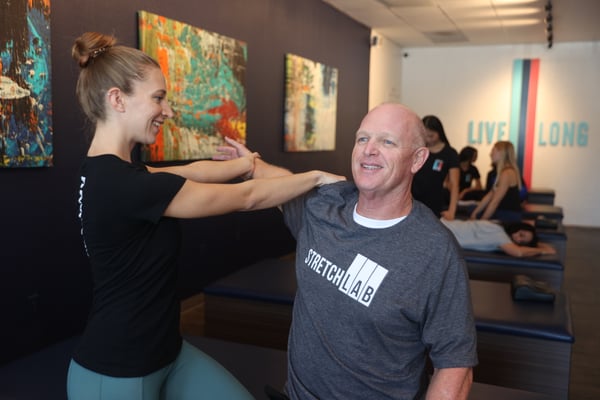
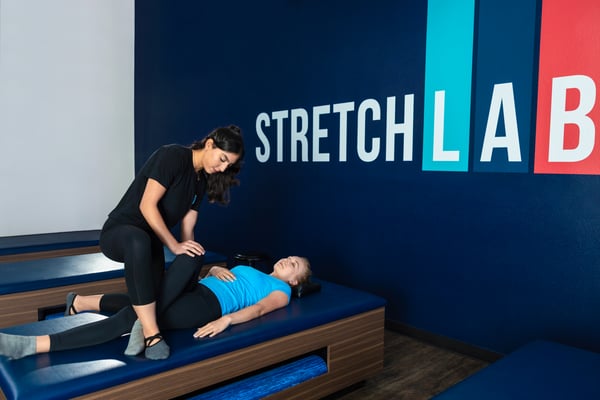
At StretchLab, stretching isn’t rushed. It’s guided, intentional, and supported.
When a trained Flexologist moves your body slowly and safely:
- Breathing naturally deepens
- Movements remain controlled
- The stretch reflex begins to calm
- Muscles receive steady, sustained input
Slow, sustained stretching stimulates receptors in the muscles and tendons that communicate directly with the brain. These signals help reduce protective guarding and encourage the body to shift toward parasympathetic activity.
The message becomes simple:
You’re safe. You can let go.
As that message is reinforced, muscle tone decreases, tension softens, and range of motion improves — not through force, but through cooperation.
The Science Behind the Reset
Research shows that gentle, sustained stretching can:
- Lower heart rate
- Reduce cortisol (the stress hormone)
- Improve circulation
- Increase parasympathetic activity
- Decrease pain perception
When the nervous system relaxes, muscles become more receptive to lengthening. That’s why many clients find they can move farther and more comfortably on the stretch bench than they ever could on their own.
Flexibility, it turns out, is less about forcing your body and more about earning its trust.
Stretching as Nervous System Training
Each session at StretchLab functions as nervous system training.
Just as you train strength or endurance, you can train your body to access a calmer state more efficiently. With consistent assisted stretching, the body becomes better at shifting out of tension and into recovery.
Over time, clients often notice:
- Improved posture and alignment
- Reduced chronic tightness
- Enhanced workout recovery
- Better sleep quality
- Lower overall stress levels
Many report feeling not just looser, but lighter and more centered. That shift isn’t just muscular — it’s physiological.
Performance Improves When You Slow Down
Here’s the paradox: slowing down can help you perform better.
Tight, guarded muscles restrict joint mobility and limit efficiency. When your body operates in protective mode, movement becomes harder and less coordinated.
By calming the nervous system and restoring mobility, assisted stretching helps you:
- Move with greater ease
- Access fuller range of motion
- Reduce injury risk
- Recover more effectively
- Feel more connected to your body
In other words, slowing down at StretchLab can help you move better everywhere else.
More Than a Stretch — A Reset
One of the most overlooked benefits of assisted stretching is the mental reset.
In a day filled with noise and demands, time on the bench offers space to pause. To breathe. To be guided rather than pushing yourself.
Clients often describe sessions as:
- “The calmest part of my week.”
- “A reset button for my body.”
- “Therapy for my muscles — and my mind.”
That experience isn’t indulgent. It’s restorative.
Permission to Slow Down
Your body wasn’t designed for constant overdrive. It needs cycles of effort and recovery.
StretchLab creates space for that recovery — a place where slowing down is encouraged, not judged.
So when you feel tight, overwhelmed, or worn out, remember: progress doesn’t always come from doing more.
Sometimes it comes from lying down, breathing deeply, and allowing your nervous system to remember how to relax.
And that just might be the most productive stretch of all.
Ready to Experience the Reset for Yourself?
Discover how personalized assisted stretching can help calm your nervous system, release tension, and restore how your body moves. Book your Intro Stretch today.
About the Author:

Bonnie Strati has been a Flexologist for six years and a Master Flexologist for five, bringing extensive experience in mobility, corrective exercise, and client education to the StretchLab community. She was an MTAC committee member in 2024, reflecting her leadership and commitment to excellence within the brand. Bonnie has contributed to the accreditation of the Flexologist Training Program (FTP) and was part of the team that developed key updates to the FTP curriculum. She also writes the Flex newsletters and has contributed to numerous StretchLab blogs, helping elevate education and communication across the network.
Bonnie holds a degree in Speech Communications and multiple advanced certifications, including NASM Certified Personal Trainer (CPT) and Corrective Exercise Specialist (CES). She is a 200-hour E-RYT yoga instructor, Advanced Yoga Sports Coach™, Precision Nutrition Level 2 Coach, and Reiki practitioner.
She is the author of Built Stronger: The Art of Becoming Whole Again, and her upcoming book, Calm in Chaos: Finding Peace & Happiness within the Uncertainty of Cancer, is due out in March. Bonnie is currently expanding her expertise through studies in hypnotherapy, continuing her commitment to supporting both physical performance and holistic well-being.
.jpeg?width=600&name=image1%20(2).jpeg)