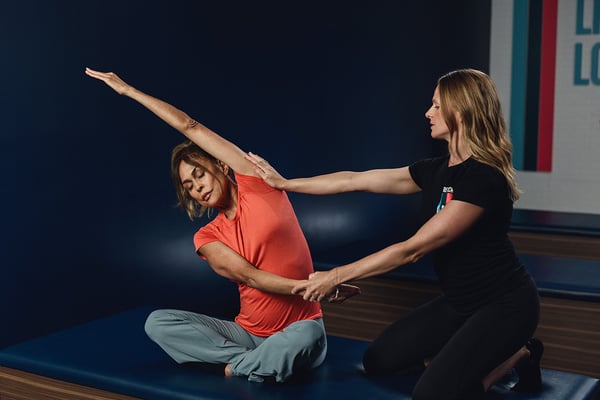
Quick TakeawayWhether you compete, race, lift or play on weekends, your sport asks your body to move through a full range again and again. Assisted stretching helps you build and keep that range. A certified Flexologist guides each stretch one-on-one, so you can reach positions that are hard to get into alone. It works best alongside strength training, conditioning, sleep and a smart warm-up. |
What Athletes Get From Assisted Stretching
- More range of motion. Regular stretching is well supported for improving range of motion, which matters for a runner's stride, a lifter's squat and a golfer's rotation.
- Positions you cannot reach alone. A Flexologist supports your body and adjusts each stretch, so you can relax into it instead of holding it.
- A plan for your sport. Your Flexologist focuses on the areas your training loads most and adjusts as your season changes.
- Consistency. A booked appointment makes mobility work happen.
What The Research Says
What it does well. A 2025 expert panel agreed that stretching improves range of motion, and recommended static or PNF stretching for building flexibility over time. (Delphi consensus statement)
Timing matters. The panel advised against long static stretches (over 60 seconds per muscle) right before all-out efforts, because they can temporarily reduce force. Short holds inside a dynamic warm-up did not show this effect. (Behm et al., systematic review)
What it is not. The panel did not recommend stretching to speed muscle recovery, and mobility work is not a complete injury prevention plan. Pair it with sleep, nutrition, easy days and progressive training.
How Often and When to Schedule It
Range of motion builds with regular stretching. StretchLab recommends a consistent rhythm, usually once a week or more. Your Flexologist builds that rhythm around your training.
|
Situation |
How it fits |
|
Rest or easy day |
A full 50-minute session on your biggest limits |
|
After training |
A comfortable-range session once you are done |
|
Before competition |
Keep it light and check timing with your Flexologist |
|
Right before an all-out effort |
Skip long static stretching and use your dynamic warm-up |
|
Off-season |
The best window to build range of motion |
How It Supports Different Athletes
- Runners: Hips, hamstrings and calves carry every stride. See our runner's guide to assisted stretching.
- Lifters and CrossFit athletes: Overhead work and deep squats need shoulder, upper back, hip and ankle mobility.
- Team and club sport athletes: Cutting, jumping and throwing load the hips, hamstrings, ankles and shoulders all season.
- Cyclists: Long hours in the saddle hold the hips flexed and the neck and shoulders reaching.
- Golfers and pickleball players: Rotation, hips and shoulders do the work. Try 3 stretches for your pickleball game.
A Member's View
Ron plays tennis. In his words:
"Since I've been coming to StretchLab, one thing I definitely notice is that I'm freer. I'm actually playing tennis now and I don't get that tightness that I had been experiencing before."
Individual experiences vary. Watch Ron's story on YouTube
What your first session looks like
- Movement Assessment. Your Flexologist learns how you move today.
- Your goals. Share your sport, schedule and any limits.
- Full Body Assessment Stretch. A certified Flexologist, who has completed a 40+ hour certification, guides you one-on-one for 25 or 50 minutes.
- A plan. You leave with a suggested program that fits your training calendar.
Learn more in what to expect from your first assisted stretch.