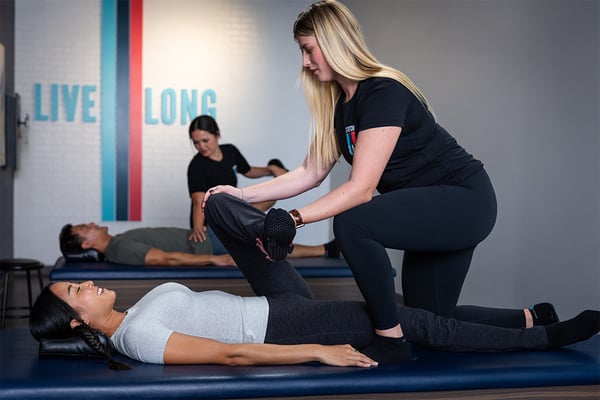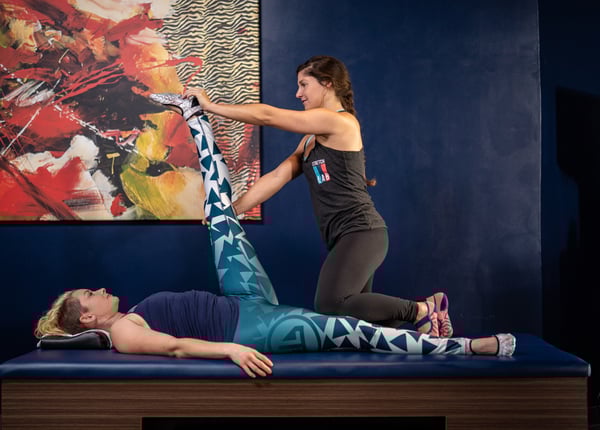
Running places repetitive stress on the same muscle groups with every stride, which makes runners especially prone to both runner's knee and IT band syndrome. Assisted stretching offers a targeted way to address the tightness behind both conditions.
What Causes Runner's Knee and How It Relates to IT Band Tightness
Runner's knee often develops when the muscles surrounding the knee lose balance in how they pull on the joint. The iliotibial (IT) band runs from the hip down the outside of the thigh and attaches near the knee. When it becomes tight, it pulls the kneecap slightly out of its natural tracking path, creating friction and discomfort on the outside of the knee. This lateral pull is why so many runners experience the two issues together rather than as separate, unrelated complaints.
Runner's Knee Recovery: Specific Assisted Stretches
Runner's knee is largely driven by tightness in the hip flexors, quadriceps, and piriformis, all of which influence how the kneecap tracks during movement. A certified Flexologist can target these muscle groups with the following assisted stretches:
- Hip flexor stretch: Lengthens the front of the hip to reduce anterior pelvic pull on the knee.
- Quad stretch: Releases tension along the thigh that contributes to kneecap tracking issues.
- Piriformis stretch: Addresses deep hip rotator tightness that can alter lower limb alignment.
- Upright runner’s lunge: Targets both muscle groups in one guided movement for efficient relief.
IT Band Syndrome Recovery: Specific Assisted Stretches
Because the IT band itself does not respond well to direct stretching, the lateral hip chain, including the TFL and glute medius, becomes the primary focus for recovery. Helpful assisted stretches include:
- TFL stretch: Encourages length through the entire lateral hip line, easing pressure at the knee.
- Side-lying IT band stretch: Targets tension along the outer thigh and surrounding connective tissue.
- Cross-body hip stretch: Targets the muscle that feeds directly into the IT band's tension.
- Hypervolt: Delivers percussive therapy to release deep muscle tightness and increase circulation throughout the lateral hip chain.
How StretchLab's Flexologists Approach Both Conditions
Stretching alone is difficult to do effectively when the goal is precise, targeted muscle release. A Flexologist can modulate depth, pressure, and angle in ways a runner cannot replicate solo, isolating the hip flexors, quads, glute medius, and TFL with far greater accuracy. This hands-on approach allows for controlled overpressure and joint positioning that safely deepens a stretch without guesswork. For runners managing runner's knee or IT band syndrome, this level of control often makes the difference between temporary relief and meaningful progress.
When to See a Professional vs. Stretch Through It
Assisted stretching is generally appropriate during active recovery once sharp, acute pain has subsided and only tightness or dull discomfort remains. If pain increases during or after a stretch, it is a signal to pause and consult a healthcare provider before continuing. Healthy runners without current symptoms can also benefit from preventive sessions, since the same muscle groups, hip flexors, quads, TFL, and glute medius, tend to tighten with regular mileage before any injury develops.
Book Your Session Today
Ready to give your hips and knees the targeted care they need? Find a StretchLab studio near you and book your session today.